An old cricket whose wood is firm but whose metal has rusted
Strip and reline it, renew the side valleys
Decking is tested from the attic before we decide.
 Proudly American · Family owned and run in Spring Hill
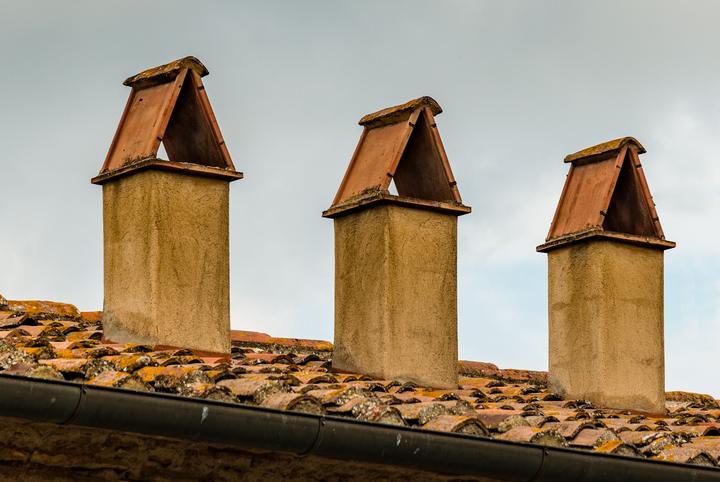
A peaked saddle behind a wide chimney that sends rain and leaves around the stack, not into your ceiling.
Request a Free Inspection
Request Received
Thanks, your request is with us. Expect a call from our Spring Hill family to book the free inspection.
Quicker by phone? Call (352) 663-0381

Book your chimney cricket within 72 hours of your free inspection and take 10% off.
A chimney cricket, also called a saddle, is a short ridge framed behind a chimney on the high side of the roof. Rain and leaves hit its point and slide off to both sides instead of piling against the stack. Florida code section R1003.20 requires one on a chimney over 30 inches wide that stops below the ridge.
So what is a chimney cricket? Stand in the yard and look at the high side of a wide chimney. If there is a cricket, you see a little triangle of roof behind the stack, its point aimed up the slope. Rain coming down meets that point and is pushed left and right into two shallow valleys that run past the sides of the chimney. Without it, the same rain runs straight into the chimney's back wall and slows to a stop.
Roofers also call it a chimney saddle, and the job is the same under either name. Slow water is the problem. It drops the leaves and grit it was carrying, those build a little dam, and the dam holds water against the joint between roof and chimney for hours after the storm has passed. Every joint eventually gives way to that, which is why a stain on the ceiling below the high side of a chimney can trace back to a missing or failed cricket.
The trigger is in section R1003.20 of the Florida Building Code, Residential: a cricket is required where the side of the chimney that runs parallel to the ridge measures more than 30 inches and the chimney does not reach the ridge. A chimney that pokes through the ridge itself sheds water both ways on its own.
How tall the cricket must be comes from Table R1003.20. It ties the height (H) to the chimney's width (W) and the roof's pitch, and the steeper the roof, the taller the cricket. Read from the table:
Nearly nine in ten housing units in Spring Hill are single-family detached houses, according to the Census Bureau's 2020 to 2024 American Community Survey. Where one of those houses has a factory-built fireplace, the chimney on the roof is usually a framed chase: studs, sheathing and siding or stucco wrapped around a metal pipe. A wide chase below the ridge dams water the same way a brick stack does.
Section R1003.20 sits in the code's chapter on masonry chimneys, but the water does not read code chapters. A chase is a framed wall meeting a roof, and section R703.4 lists both wall-to-roof intersections and chimney intersections with frame walls as places that must be flashed.
On a truss roof we do not cut or notch the trusses. The cricket is framed on top of the existing roof sheathing, sheathed, and lined with metal. The difference from brick is at the back wall: instead of counter flashing set into a mortar joint, the cricket's metal turns up the chase wall and the house wrap and siding lap down over it, with the upper layer over the lower so water always runs outward. If the chase siding is rotted where it meets the roof, that part of the chase is repaired before the cricket goes on.
On masonry the seal is made in two layers. The cricket's metal lining is slipped under the shingles or tile above it, bent down into the two side valleys, and turned up the back of the stack a few inches. A second piece, the counter flashing, is set into a groove cut in the mortar and folds down over the top of that turn-up, so water running down the brick lands on the outside of the lining. Shingles are lifted and relaid; tile is lifted by hand and reset. When the metal along the sides and front is tired too, the same visit can include chimney flashing repair so the stack is sealed all the way around.
An existing cricket often fails at the metal, not the wood. If the sheathing under it is firm from the attic side, we pull the old lining, renew the valleys and reseal the back wall. If the decking is spongy, the cricket was built so flat it holds water, or a wide stack never had one, a new cricket is framed. Where water has already come through, the drywall and framing inside are handled as chimney leak repair.
We walk the roof, measure the chimney or chase and the pitch, and look at the decking from the attic where it can be reached. That visit is free. Before anyone carries tools up the ladder, the written estimate spells out how tall the cricket will be, what metal lines it, and how much roofing comes up and goes back. Our experienced crew works for a local, family-owned company, Proudly American, and leaves the roof and the yard clean.
What is already behind your chimney sets the job.

Leave your details and we will call back to pick a time that suits you.
Request Received
Thanks, your request is with us. Expect a call from our Spring Hill family to book the free inspection.
Rain sliding down a roof has to go somewhere when it meets the broad back of a chimney, and without help it stops and pools. A chimney cricket gives it a ridge to split on. Our local, family-owned crew builds that ridge on the roof deck, seals it into the roofing and the chimney face, and begins with a free inspection of the roof.
Run by a Spring Hill family: experienced hands, a written estimate before work starts and a workmanship warranty on our repairs.







We measure your chimney and roof pitch for free, and our Proudly American family crew puts the cricket it needs in writing.
The inspection costs nothing. Schedule any service in the 72 hours after it to get a 10% discount.
Request Received
Thanks, your request is with us. Expect a call from our Spring Hill family to book the free inspection.
Quicker by phone? Call (352) 663-0381