Brick stack failing above the roof, fireplace still wanted
Rebuild the stack instead of removing it
Compare a rebuild estimate before you decide.
 Proudly American · Family owned and run in Spring Hill
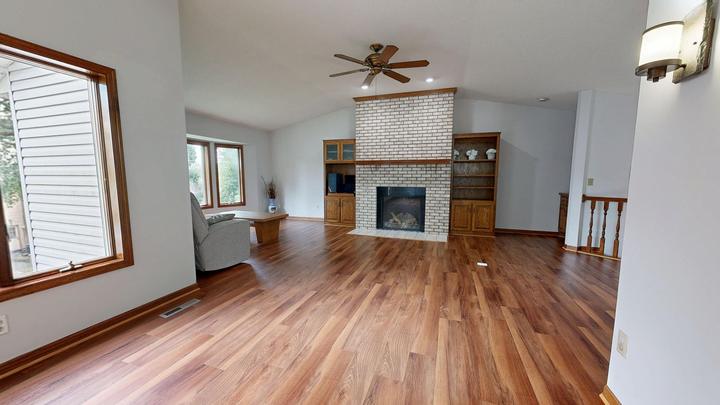
An old chimney taken down cleanly, and the roof, wall and ceiling closed so nobody can tell where it stood.
Request a Free Inspection
Request Received
Thanks, your request is with us. Expect a call from our Spring Hill family to book the free inspection.
Quicker by phone? Call (352) 663-0381

Book your chimney removal within 72 hours of your free inspection and take 10% off.
Chimney removal takes an unused chimney down to the roofline, the roof deck or the ground, then closes every opening it leaves. On a framed chase the work is mostly carpentry and roofing; on a brick or block stack it is masonry demolition. A structural check comes first wherever the chimney might carry other loads.
Every chimney removal starts with one decision: how far down it comes. Choosing to remove the chimney above the roofline takes off only the part that leaks and weathers, and the fireplace below is sealed and left in place. Taking it down to the roof deck removes everything outside the house. A full chimney teardown to the ground clears the wall or corner inside as well, which is the bigger job.
Whatever stops, every opening the chimney leaves is closed: the roof, the ceiling, the attic floor and the face of the old fireplace. An old chimney removal that leaves a patched hole in the roof is only half done.
Nearly nine in ten Spring Hill housing units were built in 1980 or later, according to the Census Bureau's 2020 to 2024 American Community Survey. Where a house of that age has a factory-built fireplace, the chimney on the roof is a framed chase: studs, sheathing and siding or stucco around a metal pipe.
Taking a chase down is more carpentry than demolition. The cap, chase cover and metal pipe sections come off first. The chase framing is cut back to the roof deck, and the opening in the deck is framed in from below between the trusses, never by cutting them. New decking, underlayment and roofing close the hole, matched to the roof around it.
Where the chase rose from the wall instead of the roof, the siding, soffit and fascia it covered have to be rebuilt so the wall reads as one surface. Inside, the ceiling and attic floor openings where the pipe passed are closed, and the old firebox is either removed or sealed behind a finished face. A gas fireplace removal follows the same steps, and the written estimate spells out how the unit, its vent and its gas line are handled.
Chimney demolition on masonry is done from the top down, by hand, so brick never falls onto the roof or into the house. Rubble goes down a chute or in buckets, and the roof around the stack is protected while we work. A stack taken down below the roof gets a sound top course and a cover, or the roof is framed and closed over it.
Masonry carries real weight. Section R1003.8 of the Florida Building Code, Residential, says a chimney shall not support loads other than its own weight unless it was designed for them, but older work does not always follow the rule, so we look for anything resting on the stack before it comes down. Where a chimney might carry a beam or a floor, or the footing itself is in question, the owner brings in a structural engineer before we start. Where part of a masonry chimney stays inside, the gaps where it passes floors and ceilings are kept fireblocked with noncombustible material, as section R1003.19 requires.
Spring Hill is not an incorporated city, so permits here go through Hernando County. The county's Development Services FAQ lists demolishing structures and major renovations among the work that needs a permit, and roofing and demolition among the permit types filed through its Online Permitting Portal. Where the county requires a permit for your removal, it is pulled before the work starts and the estimate says so.
A chimney removal company should show you the whole plan before anything comes apart. Ours starts with a free inspection of the roof, the attic and the fireplace, then a written estimate that names how far down the chimney comes, how the roof and walls are closed, and who handles any permit. Our local, family-owned business is Proudly American, with an experienced crew for both the masonry and the carpentry, and every brick and board is hauled away. If you would rather keep the chimney and fix it, a chimney rebuild is priced the same way.
How far the chimney comes down decides the size of the job.

Leave your details and we will call back to pick a time that suits you.
Request Received
Thanks, your request is with us. Expect a call from our Spring Hill family to book the free inspection.
Taking a chimney down is half demolition and half carpentry. Chimney removal and roof repair are one job for us. Our local, family-owned crew removes the chase or the brick, then closes the roof deck, patches the siding and soffit and seals the ceiling where the pipe or flue used to pass. A free inspection comes first, so you know exactly what has to come down and what stays.
Run by a Spring Hill family: experienced hands, a written estimate before work starts and a workmanship warranty on our repairs.







Planned removal, a closed roof and no trace of the old stack, from a Proudly American family crew.
The inspection costs nothing. Schedule any service in the 72 hours after it to get a 10% discount.
Request Received
Thanks, your request is with us. Expect a call from our Spring Hill family to book the free inspection.
Quicker by phone? Call (352) 663-0381