Corner or wall spot with room outside
Pellet vent through the wall, up and out
Window and door distances, eave height.
 Proudly American · Family owned and run in Spring Hill
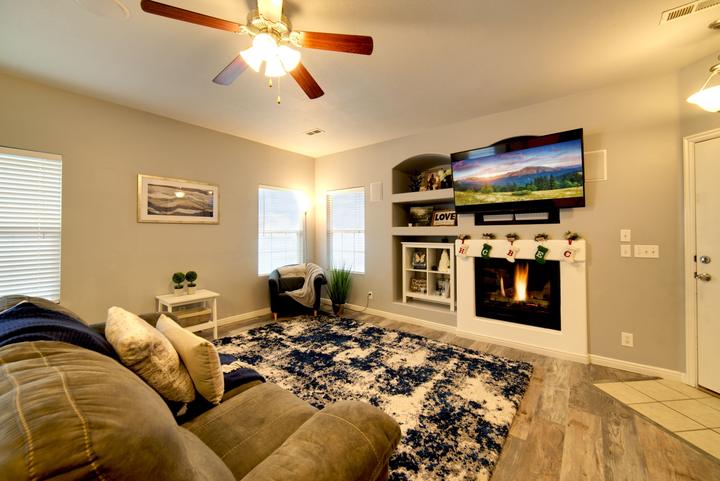
A pellet stove set where it can be serviced, vented out through the wall and up to a cap that clears windows, doors and the eave.
Request a Free Inspection
Request Received
Thanks, your request is with us. Expect a call from our Spring Hill family to book the free inspection.
Quicker by phone? Call (352) 663-0381

Book your pellet stove installation within 72 hours of the free inspection and take 10% off.
A pellet stove installation done to the maker's manual sets the stove on a noncombustible pad, keeps the clearances on its label and runs a listed pellet vent out through a wall or up an existing chimney. The technician also connects outside air where the maker asks for it, plugs the stove into a grounded outlet and runs a start-up test.
Where a pellet stove goes in a corner of the living room where two outside walls meet, it stays out of the walkway and the vent can leave through the wall right behind it. Drolet's installation manual for its Eco-55 shows how close that can be: in a corner, a minimum of 3 inches from each wall, with 12 inches recommended so the stove can still be serviced. Set flat against a wall, the same stove needs 3 inches at the back and 6 inches at the side, and the vent pipe keeps whatever distance its own maker sets.
Those numbers belong to one stove. Every pellet stove carries its own clearances on its label, tested to ASTM E1509 under the Florida Building Code, section M1410.1, and the manual adds that no part of the stove may sit closer than the label allows. We measure from your stove's label and leave room for the panels and the hopper lid to open, because a stove that cannot be reached is a stove that does not get cleaned.
A pellet stove vent is not a dryer duct. It is a listed pellet vent pipe, 3 inches across on the Eco-55, sealed at every joint, and in the United States Drolet asks for one listed to UL 641. The manual keeps horizontal runs to 9 feet, asks for at least a foot of rise for every foot of sideways run, and wants at least 3 feet of vertical rise in every installation. That rise gives a natural draft, which keeps smoke out of the room if the power goes out and the exhaust blower stops.
For a through-the-wall pellet stove pipe installation, the pipe passes through a wall thimble, extends 6 inches past the siding into a tee with a cleanout, and climbs the outside wall at least 36 inches. It then turns out with an elbow and points down with a second elbow and a spark arrester at the end. Elbows count against the total: in the manual's arithmetic a 90-degree elbow counts as 5 feet of pipe, and past 15 feet of equivalent length the vent steps up to 4 inches. The thimble is sealed to the wall with high-temperature silicone so rain cannot follow the pipe in.
In every pellet stove vent installation, the vent is never shared with another appliance and never gets a damper. The manual allows only a listed pellet vent or a lined chimney, and never a connection to air ductwork or to a vent that already serves something else.
Pellet exhaust can reach 500 degrees Fahrenheit, so the cap's position is set by distances, not by looks. The Eco-55 manual, which points to NFPA 211 for the full rules, keeps the termination at least 48 inches below or to the side of, or 12 inches above, any door, window or air inlet that opens into a building. It stays at least 12 inches above the ground, 24 inches from a neighboring building, and away from a gas meter or regulator. A forced-air inlet within 10 feet needs the cap at least 36 inches above it.
In a corner, that table often decides which of the two walls the vent goes through. One wall may have a window too close, the other a patio door. Below an eave, the 36 inches of rise the manual asks for has to fit under the overhang with room for the cap. We draw the cap position on the outside wall before anything is cut and check every distance on that drawing.
Even a stove that keeps the floor cool needs protection from a hot pellet that falls out when the door opens. Drolet asks for a continuous, grouted noncombustible surface such as ceramic tile, cement board, brick or millboard, or a listed floor protector, reaching 6 inches past the door opening at the front and sides on the Eco-55. Tile needs a continuous noncombustible sheet underneath so an ember cannot reach the wood through a cracked grout line.
A pellet stove such as the Eco-55 can draw combustion air from outside through a short insulated pipe. Drolet recommends an outside air inlet in or near the room, on a wall that does not face the strongest winds, with a rodent guard of at least quarter-inch mesh at the inlet. The manual forbids drawing combustion air from an attic, a garage or any closed space. For a manufactured home, the Eco-55 manual makes outside air mandatory, has the stove anchored to the floor and rules out a sleeping room.
A pellet stove also runs on house power. It plugs into a grounded 120-volt outlet with no adapter, and the cord never runs under, in front of or over the stove. Where no outlet is close to the corner, that is part of the plan from the first visit.
A house with an unused fireplace can sometimes vent a pellet stove or a pellet insert up the old chimney. Drolet's manual allows it with a stainless steel liner, listed to UL 1777, run from the stove to the top, and says the liner is mandatory in the United States. On a pellet stove chimney installation, the chimney is cleaned and inspected first. In a fireplace, a stainless plate seals off the damper area around the liner, a cleanout tee sits at the bottom, and the top of the chimney is closed with a plate sealed with high-temperature silicone. If the chimney needs repair before it can carry a liner, we tell you before you buy the stove. For a pellet stove insert installation, the insert's own manual sets the liner and the seal, and we follow it.
New pellet stoves must meet the same EPA emission limits as new wood stoves. At start-up we fill the hopper, run the stove through its lighting cycle, check that the vent draws and nothing leaks at the joints, and go through the controls and the owner's maintenance steps with you. You keep the manual and our written record of the installation. Cleaning and repair later on are part of our pellet stove service.
A pellet vent run the wrong way or a cap placed too near a window can let exhaust into the house, which is why the clearances on this page are not do-it-yourself guesses. Spring Hill Chimney Family is family-owned and locally run, Proudly American, with experienced pellet stove installers who read your stove's manual before the first cut. Every pellet stove plan begins with a free inspection and a written estimate.
The vent route follows the house.

Leave your details and we will call back to pick a time that suits you.
Request Received
Thanks, your request is with us. Expect a call from our Spring Hill family to book the free inspection.
Placing a pellet stove is mostly a question of the vent. The stove needs an outlet for its blower, the vent needs a short path outside, and the cap outside needs room away from windows and doors. Our family-run Spring Hill crew walks the room and the outside wall with you, then writes up a plan and a price after a free inspection.
Run by a Spring Hill family: experienced hands, a written estimate before work starts and a workmanship warranty on our repairs.







A local, Proudly American family crew marks the cap on your wall before anything is cut.
The inspection costs nothing. Schedule any service in the 72 hours after it to get a 10% discount.
Request Received
Thanks, your request is with us. Expect a call from our Spring Hill family to book the free inspection.
Quicker by phone? Call (352) 663-0381