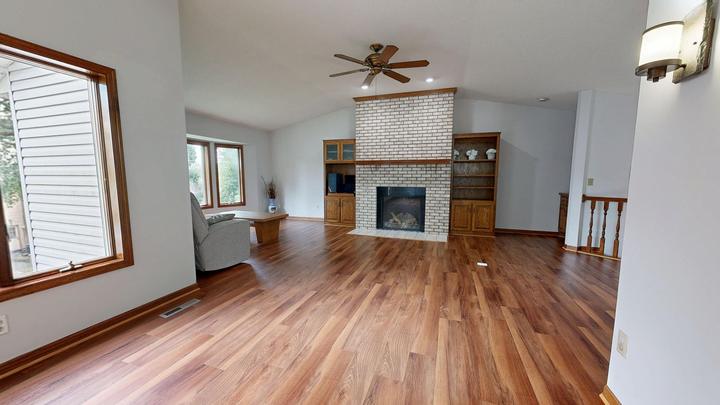
What the Vents Above and Below a Fireplace Are For
Louvers on a circulating fireplace, and why they are never covered.
Request a Free Inspection
Request Received
Thanks, your request is with us. Expect a call from our Spring Hill family to book the free inspection.
Quicker by phone? Call (352) 663-0381
Circulating and Radiant Fireplaces
Factory-built wood fireplaces come in two broad kinds. A radiant, or noncirculating, unit heats the room only by what the fire throws out through the opening. A circulating unit adds a channel of air around the firebox, with a row of louvers below the opening and another above it. The Superior Pro Series manual shows both in its drawings and lists a louver assembly as a part for circulating models only, with the top and bottom louvers the same size.
If you have slotted metal grilles above and below the firebox, built into the black metal face, you almost certainly have a circulating fireplace. If the face is solid metal around the opening, it is radiant.
- Lower louvers: below the opening, at or near hearth level.
- Firebox: the steel box lined with refractory panels.
- Air channel: the space between the firebox and the outer casing.
- Upper louvers: above the opening, where the warmed air comes out.
- Blower, on some models: mounted in the lower channel.
What the Grilles Do
Cool room air is drawn in through the lower louvers, passes up the channel behind and around the hot firebox, and leaves through the upper louvers warmer than it came in. The fire never touches that air; it is a separate path from the smoke, which goes up the chimney. That loop adds a stream of warm air to the heat thrown out through the opening.
Some circulating units take an optional blower. The Superior manual says its fan kit is for circulating models only and that blowers from other makers void the warranty. A blower simply pushes more air through the same channel, so it only helps when the louvers are clear.
Why They Must Stay Open

The air moving through the channel also helps keep the outer casing and the wall around the fireplace cool. Section R1004.1 of the Florida Building Code, Residential, requires a factory-built fireplace to be installed in accordance with its listing, and the listing assumes that air can flow. The Superior manuals spell it out: the hearth extension drawing for circulating models is marked do not block louver, noncombustible facing may cover the metal face only if it does not obstruct the louvered slots, and wood trim must stay at least 9 inches from the top louver opening.
Block the lower louvers with a rug, a raised hearth, a decorative panel or a stack of logs, or cover the upper ones with tile or a mantel, and the channel stops moving air. Heat that used to come into the room stays in the casing instead, beside framing that was only cleared for a fireplace with moving air.
Checks on Fireplace Louvers
These are the checks we make on a circulating fireplace, and most of them you can make yourself with the fireplace cold.
- Nothing in front of the lower louvers: no rug edge, basket, hearth add-on or logs.
- No tile, stone or trim overlapping the louvered slots at top or bottom.
- Mantel and wood trim at least the maker's distance from the top louver.
- Louvers clean and seated; on the Superior units they lift out on spring hinges for cleaning.
- Blower, if fitted, running quietly and only the maker's model.
Other Handles and Openings on the Face
Not every opening on the face is a louver. The Superior Pro Series has a damper handle in the upper front face and an outside air kit handle at the left side: pull it out to open the outside air door, push it in to close it. Those are controls, and they have their own instructions. If you find a grille you cannot identify, read the fireplace's rating plate for the model and find its manual before covering or changing anything.
Covered Louvers in a Remodel
- Mantel shelf
- Fireplace facing
- Firebox opening
- Hearth
- Wall above the mantel
One way louvers get blocked is a refacing job that tiles right over them or a new mantel set too low. If that has happened, stop using the fireplace until it is checked. Our prefab fireplace repair crew opens the slots, refits louvers and blowers with listed parts, and checks the casing for heat damage; our wider fireplace repair work covers the firebox and damper.
Refacing mistakes are fixable, and our experienced crew has the listed parts knowledge to do it right. We are a local company, owned by a family and Proudly American, and every free inspection by our Proudly American crew comes with a written estimate.
Homeowner Guides
Questions and Answers
How does a zero clearance fireplace work?
Do zero clearance fireplaces give off heat?
Can I close the vents on my fireplace?
Related Services
How a Visit Works

Proudly American
Run by a Spring Hill family: experienced hands, a written estimate before work starts and a workmanship warranty on our repairs.

10% Off Work Booked in the 72 Hours After Your Inspection
The inspection is free. Any service booked in the 72 hours after it is 10% off.

Request Your Free Spring Hill Inspection
Leave your details and we will call back to pick a time that suits you.
- Free inspection and a written estimate
- Same-day service available
- Family owned and run in Spring Hill
Request Received
Thanks, your request is with us. Expect a call from our Spring Hill family to book the free inspection.

Catch the Chimney Problem While It Is Small
Ask for a free inspection at your Spring Hill home and see a written estimate before any work begins.